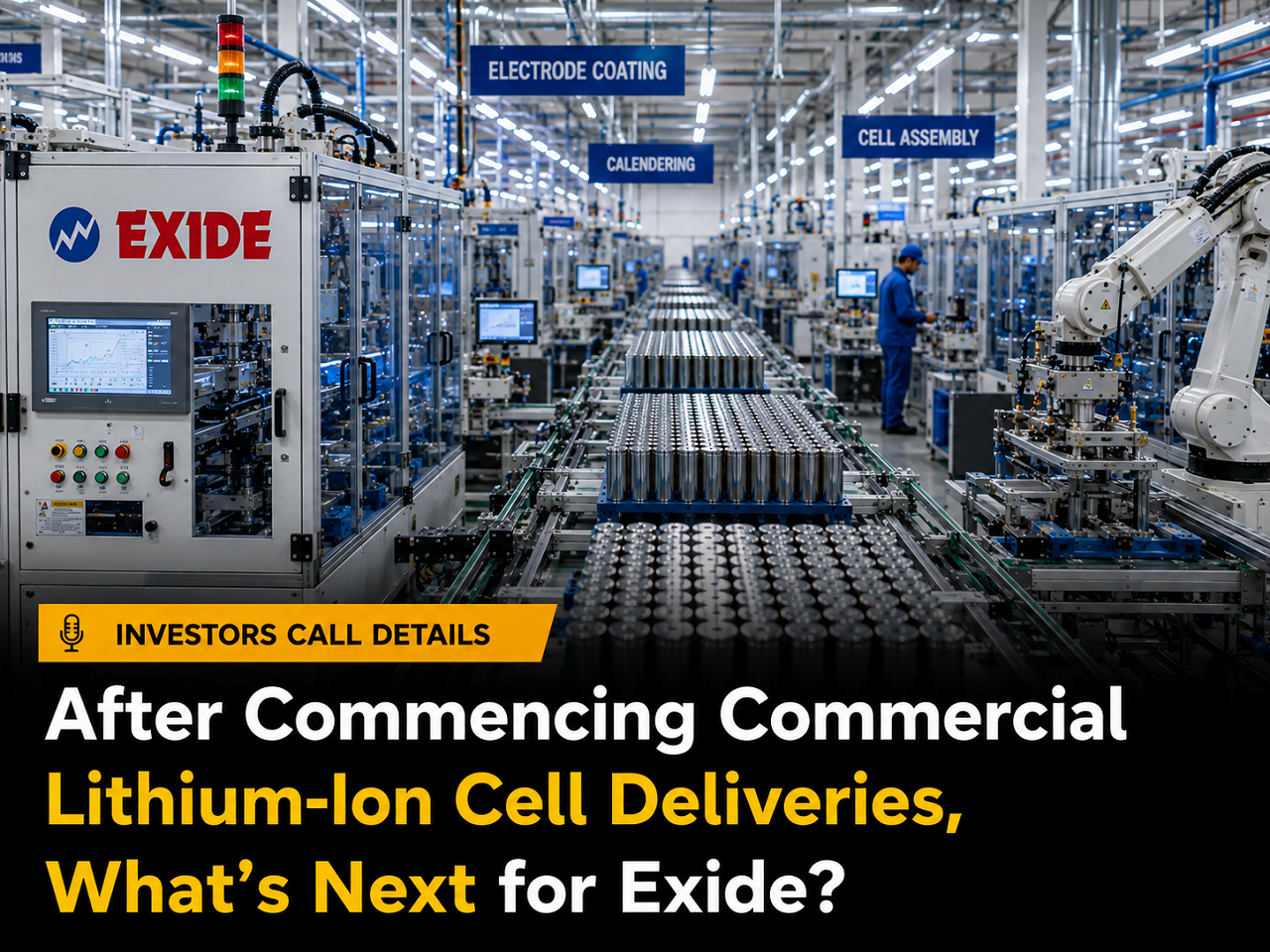
After Commencing Commercial Lithium-Ion Cell Deliveries, What's Next for Exide?
India
August 5, 2026
Exide Industries has crossed a key milestone in India's advanced battery manufacturing journey by commencing commercial deliveries of locally manufactured lithium-ion battery cells from its Bengaluru gigafactory. But for the nearly ₹5,000-crore investment, the bigger story now lies ahead—scaling production, entering the fast-growing battery energy storage system (BESS) market, expanding into electric vehicles, and capitalising on an expected policy push for domestic cell manufacturing. The company has begun customer deliveries from its first NMC cylindrical cell production line, while sample supplies from its LFP prismatic line have also commenced for three-wheelers and telecom applications. Management expects the gigafactory to start contributing revenue during FY27. Four Production Lines to Address Multiple Markets Rather than focusing on a single battery chemistry or application, Exide is building four production lines targeting different segments. The first NMC cylindrical line has already entered commercial production. The LFP prismatic line is supplying samples for three-wheelers and telecom applications, while another production line is expected to cater to passenger vehicle manufacturers. A fourth line has been earmarked for large-format lithium iron phosphate (LFP) cells designed for Battery Energy Storage Systems (BESS). Management said the BESS line will manufacture cells exceeding 300 Ah capacity, which have become the preferred format for utility-scale storage projects. Perhaps the most significant takeaway from Exide's earnings call was its emphasis on stationary storage. The company believes BESS offers a shorter route to market than automotive applications because it does not involve lengthy OEM homologation processes. It also expects domestic procurement policies and government tenders to increasingly favour locally manufactured battery cells. For a company traditionally known for lead-acid batteries, this marks a strategic shift towards supplying the rapidly expanding utility-scale energy storage sector. 'BESS Market is Being Misunderstood' Management also offered an interesting perspective on the evolving storage market. According to Exide, much of the industry is currently focused on assembling battery containers, whereas the real technological value lies in manufacturing battery cells, battery racks, battery management systems (BMS) and associated electronics and software. The company indicated that localisation should extend beyond steel containers to the core technologies that determine battery performance and reliability. Exide does not expect demand generation to be a challenge. Management said India's EV and stationary storage markets already rely heavily on imported battery cells. The company's immediate opportunity is therefore to replace imports with domestically manufactured cells rather than create an entirely new market. It also disclosed that it is working with three major electric two-wheeler manufacturers accounting for around 80-85% of India's EV market and has begun discussions with leading passenger vehicle OEMs. Management indicated that it expects greater policy support for local cell manufacturing as India's production capacity expands. While the company is evaluating the government's fresh ACC PLI opportunity, it also suggested that India could eventually introduce an Approved List of Cell Manufacturers, similar to the Approved List of Models and Manufacturers (ALMM) framework in the solar sector, once sufficient domestic manufacturing capacity is established. Solar Business Also Gains Momentum Alongside its new energy business, Exide's conventional operations continued to perform strongly. The company reported that its solar business recorded its highest-ever quarterly revenue of over ₹400 crore, while the home inverter and solar segment grew by more than 20% year-on-year, supported by robust summer demand. Exide has already invested ₹4,902 crore in its lithium-ion subsidiary and plans to expand from an initial 6 GWh to 12 GWh as demand grows. The company said utilities for the full 12 GWh facility have already been installed, reducing the capital required for the second phase of expansion.