What L&T Wants From Drone Startups: Deep IP, Deployable Tech and Scale
India
August 9, 2026
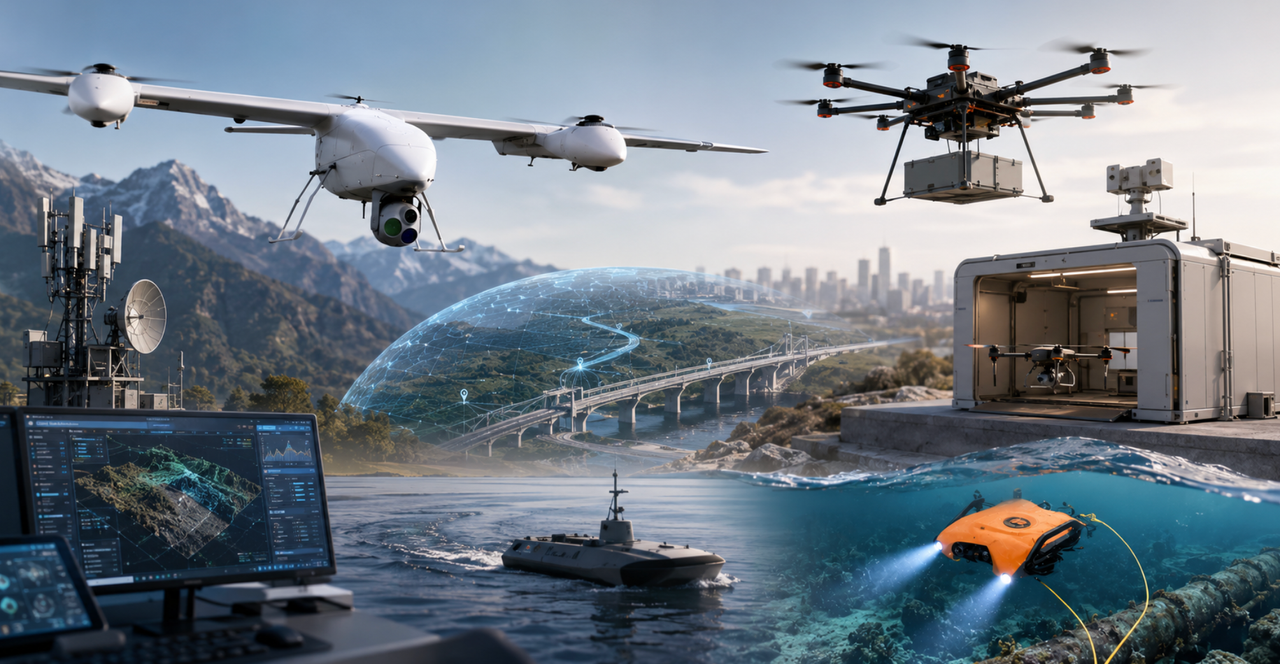
India has no shortage of startups capable of putting a drone in the air. The more important question is what sits inside the aircraft, what happens when GPS disappears, what intelligence it produces after a mission, and whether the technology can be manufactured and deployed repeatedly at scale. That was the more interesting startup story at L&T Manthan – Drone Demo Day in Bengaluru. Larsen & Toubro brought together 21 drone and uncrewed-systems startups spanning aerial logistics, defense, autonomous navigation, counter-drone systems, propulsion, batteries, radio-frequency intelligence, geospatial AI, and underwater robotics. The technologies were diverse, but they pointed toward the same shift: India's unmanned-systems startup ecosystem is moving beyond the airframe. The Airframe is No Longer The Whole Story L&T's own approach to the event offers a clue to what it is looking for. The L&T Innovation Fund uses Manthan to identify, evaluate, and potentially scale emerging technologies across the group. Drone Demo Day was intended to identify deployment-ready technologies, possible proof-of-concept opportunities, and areas for co-development and IP-led partnerships. For a startup, that means the bar is higher than an impressive flight demonstration. Arun T. Ramchandani, Senior Vice President and Head, Precision Engineering and Systems IC, Larsen & Toubro, described many of the technologies beneath the finished aircraft as the “difficult middle of the value chain.” They include propulsion, batteries, navigation, flight-control computers, sensors, secure communications, electronic warfare, mission software, AI, simulation, testing, and certification. The mix of startups at Manthan reflected that requirement. Autonomy Without Perfect Connectivity Several startups are addressing one of the hardest drone problems: how to continue operating when a pilot, network, or satellite-navigation signal cannot be continuously relied upon. Vecros Technologies develops onboard AI and visual-navigation systems designed for autonomous flight without GPS. Its portfolio includes the JETCORE compute module, JETPIX OS, Jasper indoor drone, and ATHERA defense UAV. The underlying proposition is edge autonomy. Cameras, sensors, and onboard computing allow the aircraft to navigate without depending continuously on cloud connectivity or a pilot. SUIND Autonomous Systems also uses onboard vision for autonomous operations in difficult low-altitude environments. Its Wasp aerial-intelligence UAV targets inspection, perimeter surveillance, and construction monitoring, while Bumblebee is designed for autonomous agricultural operations. Redwing tackles long-range operations through its Atlantis beyond-visual-line-of-sight autonomy stack, which manages navigation, safety, and fleet operations even in weak-network conditions. NXTQUBE takes another source of human intervention out of the equation. Its drone-in-a-box architecture is designed to launch an aircraft automatically, conduct a scheduled inspection or surveillance mission, return to its docking station, recharge, transfer data, and prepare for another flight without an onsite pilot. For enterprise users, that transition could be crucial. The economics of industrial drones become more attractive when an organization does not have to send a pilot to an asset every time it needs to be inspected. Heavy-Lift Drones Move Into Logistics Another set of startups is pushing drones beyond imaging and surveillance and into physical logistics. EndureAir Systems develops autonomous heavy-lift UAVs for logistics, defense, and emergency response. Its platforms support payloads ranging from 10 kg to 70 kg and target mountainous and inaccessible locations. BONV Aero is also focused on high-altitude logistics, including moving supplies, tools, and other material to remote project sites and locations with poor road access. Amber Wings combines surveillance and cargo systems. Its ATVA-1 hybrid VTOL takes off vertically before transitioning to fixed-wing flight, while the M50 is designed to work as an aerial lifting platform for moving materials around project sites. For L&T, those use cases have obvious relevance across infrastructure, construction, energy, defense, and operations in difficult terrain. The change in the business case is important. A drone is no longer only collecting information. It can increasingly become part of the logistics network itself. Autonomy Is Also Moving Underwater The startup portfolio also shows why “drone ecosystem” is becoming too narrow a description for the market. EyeROV , based in Kochi, develops indigenous underwater drones, autonomous surface vessels, and AI-powered marine and industrial inspection systems. Its portfolio includes the TUNA commercial inspection remotely operated vehicle (ROV), TROUT for defense and offshore applications, TSROV for tunnel inspection, and the i-Boat Alpha autonomous surface vessel. The systems are designed to inspect dams, tunnels, ship hulls, pipelines, ports, and offshore platforms remotely, reducing the need to send divers into hazardous or difficult-to-reach environments. AquaAirX addresses cross-domain operations differently. Its AVATAAR amphibious drone is designed to fly to a location, land on water, descend below the surface for inspection or surveillance, and return. The two companies illustrate how the autonomous-systems opportunity is extending into surface and subsea robotics, with industrial inspection providing a common commercial use case. Every Drone Market Creates A Counter-Drone Market As drones become cheaper and more accessible, technologies for detecting, understanding, and stopping unauthorized aircraft are becoming a parallel opportunity. Unmannd Autonomy develops heavy-lift UAVs alongside its FURY counter-UAS interceptor system, which uses autonomous interceptors against hostile drones and swarms. Megh Robotics develops handheld and portable UAV neutralizers, customized UAVs, payload systems, and heavy-payload unmanned ground vehicles. Kawa Space addresses the sensing layer. Its wideband radio-frequency payload spans 0.5–40 GHz and is intended to capture and analyze electronic emissions to help defense users identify communication, radar, and other signals. The cluster demonstrates a second-order effect of drone proliferation. The more unmanned platforms enter service, the greater the demand for spectrum intelligence, electronic protection, detection, classification, and interception. The Components Nobody Sees Three startups illustrate another part of the market that rarely gets the same visibility as complete aircraft. Nautical Wings Aerospace develops indigenous electric propulsion systems, UAV propellers, integrated propulsion units, and carbon-fiber components. ATWIC Research and Development builds indigenous navigation and stabilization systems, including a two-axis gyroscope and Attitude and Heading Reference System. Hastin Energy works on smart batteries and energy intelligence for aerial, ground, and underwater unmanned platforms. Its portfolio includes batteries, battery-management systems, smart chargers, communications software, and battery-health monitoring. These technologies influence endurance, stability, navigation accuracy, reliability, safety, and maintenance, even though none is as visually prominent as a completed aircraft. They also reflect L&T's larger argument that India needs to build more of the technology stack beneath the drone if it wants to reduce dependence on imported critical components. The Real Product May Begin After The Flight Another group of startups is tackling what happens after the drone collects its data. CyRAN AI Solutions converts drone imagery, live video, satellite data, and other sensor information into maps, 3D models, digital twins, defect alerts, and GIS dashboards. Birdscale Technology and Services uses drone, satellite, LiDAR, and thermal information to track construction progress, calculate earthwork quantities, build digital twins, and identify defects. JARbits combines SkyRouteX, a multi-drone command platform, with TerraLux, a geospatial-intelligence platform designed to turn drone and satellite inputs into information about landslides, floods, subsidence, construction risks, and other conditions. InDrones brings mission planning, operations, geospatial analytics, autonomous navigation, and data management together while also working on swarm and GNSS-denied technologies. For enterprises, this is an important shift. A construction company does not ultimately need thousands of aerial photographs. It wants to know whether a project is on schedule, whether a structure is deteriorating, how much earth has been moved, or whether an operational risk has emerged. The drone becomes the data-acquisition layer. Much of the commercial value is created by what the software does with that data. What L&T Wants Startups To Understand Prashant Jain, Managing Director, L&T-Vyoma and Head, Electronic Products & Systems, used his interaction at Manthan to make a broader point about what technology companies should build. His advice to startups was not to confuse short-term revenue with long-term value creation. The substance of his argument was clear: build meaningful intellectual property, validate the technology, solve an actual problem, and develop a product with the potential to scale. “We need scale, yes, but we also need technology as a differentiation,” Jain said. A young deep-tech company may have strong technology but lack large-scale manufacturing, access to enterprise customers, integration expertise, field feedback, or the ability to industrialize its product. That is where Jain sees room for a company such as L&T to participate. L&T could work with a startup on a technology or product, help scale manufacturing, provide access to customers, and feed real-world requirements back into its development. Several memoranda of understanding were signed with startups and technology partners during Drone Demo Day, according to L&T, to explore future collaboration. L&T Is Looking For Technology Platforms Jain's comments on L&T's broader electronics strategy offer another clue to the company's thinking. Rather than treating every device as a standalone product, L&T is identifying core technology and IP platforms that can be applied across multiple products and applications. That logic has direct relevance for the drone ecosystem. A visual-navigation technology capable of working without GPS can potentially serve different aircraft. A battery-management system can operate across several unmanned platforms. A propulsion architecture may find multiple OEM customers. A mission-autonomy layer can potentially work across different types of vehicles. For a startup, that changes the proposition from “we have built a drone” to “we own a technology layer that can scale across multiple systems.” For a large engineering company, the second proposition can be much more strategic. From Demo To Deployment Is The Hard Part The real measure of L&T Manthan will therefore not be how many machines flew or how many startups displayed products. It will be what happens after the demonstration. Emerging technologies still have to move through validation, integration, reliability testing, certification, manufacturing, customer acceptance, field deployment, and eventually repeat production. Ramchandani captured that challenge succinctly. “A design that cannot be produced at the required scale, quality, speed and cost is not yet a strategic capability,” he said.That principle applies just as strongly to startups. Building something that flies is no longer enough. The companies most likely to matter in the next phase of India's unmanned-systems ecosystem will be those that own difficult technology, solve a real operational problem, integrate with a wider system, and can eventually produce it reliably at scale.