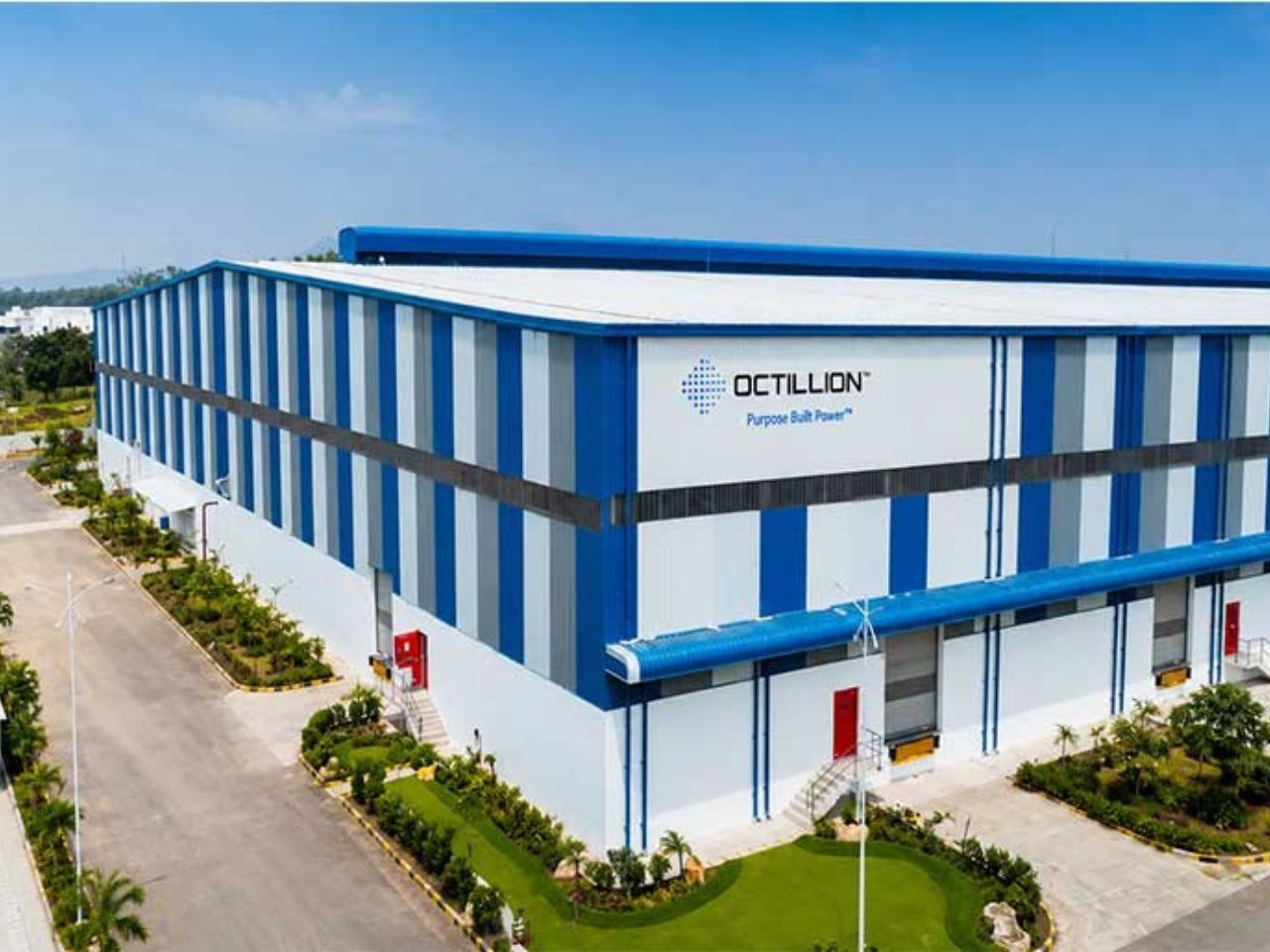
Octillion Opens Third EV Battery Plant in India With 3 GWh Annual Capacity
India
August 12, 2026
Octillion Power Systems has opened its third manufacturing facility in India, adding production capacity in Halol, Gujarat, as demand for electric vehicle ( EV ) battery systems grows across passenger, commercial and public transport segments. The facility covers more than 13,000 square metres and was converted from an empty structure into an operational battery manufacturing plant in less than eight months. 3 GWh Annual Capacity At full capacity, the Gujarat plant is expected to manufacture more than 48,000 battery systems annually, representing over 3 GWh of energy storage capacity. With the addition of the Halol facility, Octillion’s combined production capacity in India is projected to exceed 150,000 battery systems and around 9 GWh annually. The company supplies battery systems for passenger vehicles, light commercial vehicles, trucks and buses. Paul Beach, Global President of Octillion Power Systems, said, “India is one of the most important growth markets in the global transition to electric mobility, and this facility reflects our long-term commitment to building capacity where our customers need it most. Delivering a fully operational plant in under eight months is a testament to the discipline of our team and our ability to execute at speed without compromising the quality standards our customers depend on.” EV Demand Broadens Across Vehicle Segments The new facility comes as India's EV market continues to expand beyond two-wheelers into passenger cars, buses and commercial vehicles. According to JMK Research, EV sales in India increased 43% year-on-year in the first half of 2026 to more than 1.54 million units. Electric passenger vehicle sales grew 83% during the period, while electric bus sales rose 42%. Electric truck sales also recorded strong growth, with cumulative sales increasing by more than 300% year-on-year as logistics and industrial fleets increasingly adopt electric vehicles. India’s 2030 EV targets are expected to further drive demand for locally available battery systems. The government is targeting EV penetration of 30% in private cars, 70% in commercial vehicles, 40% in buses and 80% in two- and three-wheelers. Focus on Local Supply Chain Octillion’s expansion comes amid efforts to strengthen domestic battery manufacturing and reduce dependence on imported critical materials and components. The Halol facility incorporates the company’s battery production processes, thermal modelling capabilities and integrated battery management systems. Local manufacturing is expected to help shorten delivery timelines and improve supply flexibility for vehicle manufacturers. Nikhil Parchure, SVP at Octillion Power Systems, said, “A resilient EV supply chain in India can't just mean more square footage, it means depth: local sourcing, local quality control, and local engineering talent working side by side with our global standards. That's what we've built in Halol. As India moves toward its 2030 electrification targets across cars, trucks, and buses, our customers need a partner who can scale with them without exposing them to global supply chain volatility, and that is exactly the role we intend to play.”