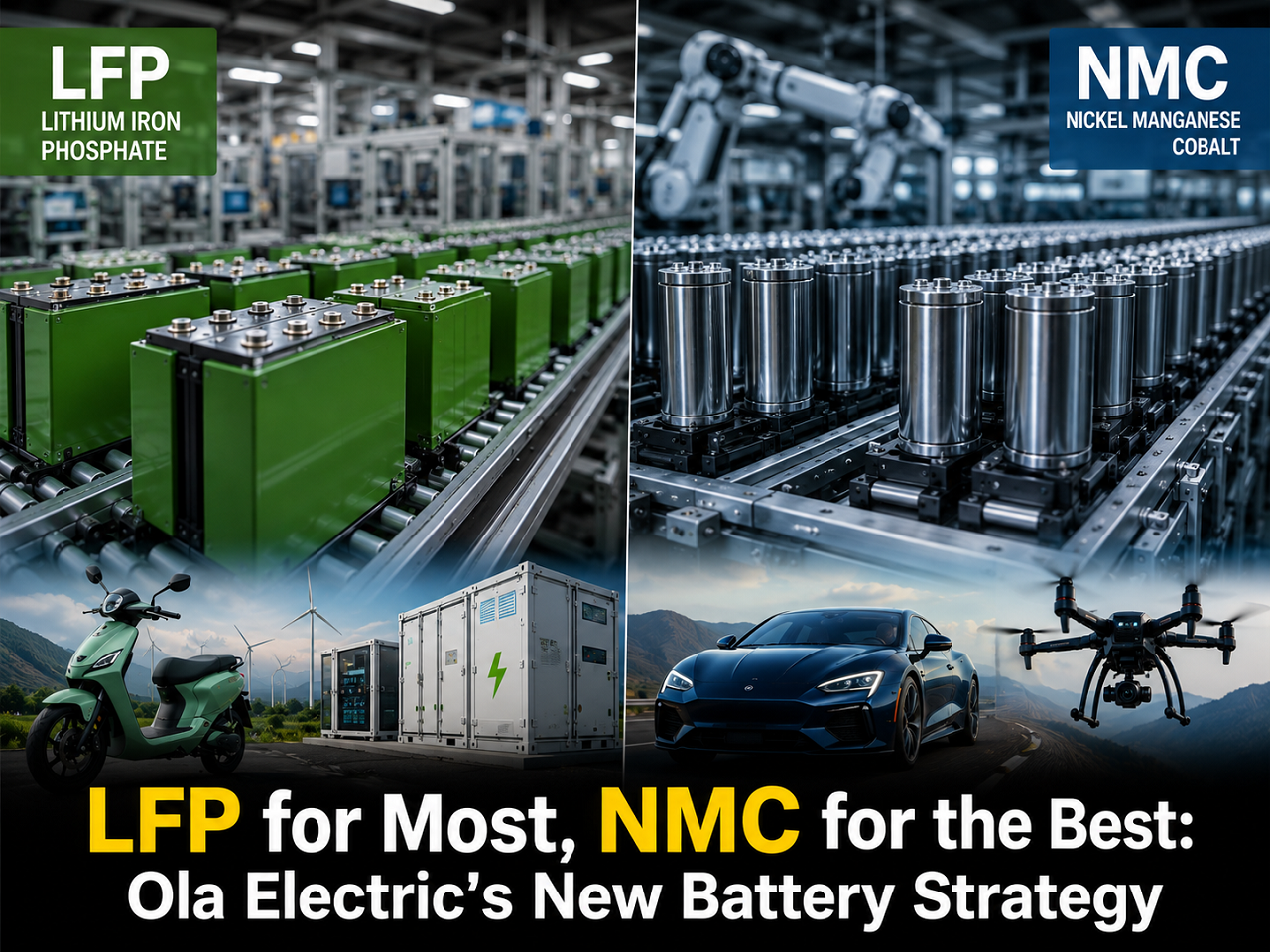
LFP for Most, NMC for the Best: Ola Electric's New Battery Strategy
India
August 26, 2026
Ola Electric is reshaping its battery strategy around two different lithium-ion chemistries, with lithium iron phosphate (LFP) expected to become the dominant technology across its mass-market electric vehicles and energy-storage products, while nickel manganese cobalt (NMC) cells will be retained for premium, high-performance applications and selected emerging markets such as drones. The strategy marks a shift from treating battery cells primarily as an input for its electric two-wheeler business to building a broader cell-manufacturing platform that can serve electric vehicles, energy storage and other applications. “We will have some good announcements there. And NMC in our Auto business, about 20% of our portfolio will be NMC-based, which will be higher performance or higher—the top end of the range will be NMC-based. Otherwise, everything else will move to LFP,” Ola Electric Chairman and Managing Director Bhavish Aggarwal told analysts during the company's Q1 FY27 earnings call. Under the plan, roughly 80% of Ola's Auto portfolio will eventually use LFP cells, while around 20% will continue with NMC. All of the company's Shakti and Mahashakti energy-storage products will use LFP, while NMC could find additional applications in areas such as drones, where the company said several customers are already testing its cells. The Two Lithium-Ion Chemestries LFP (lithium iron phosphate) and NMC (nickel manganese cobalt) are two different lithium-ion battery chemistries with different strengths. “With Shakti Gen 2 using LFP cells, we expect gross margins to be even healthier than in our Auto segment,” Aggarwal said. That chemistry strategy is now being backed by Ola's own cell manufacturing programme. The company is in the final stages of commissioning its 6 GWh cell manufacturing capacity. Ola had previously installed 2.5 GWh of capacity and produced several hundred thousand cells, some of which were already deployed in customer vehicles. Production was paused during the quarter to complete the installation of the remaining capacity. Aggarwal said the work would be largely completed in August, after which production would restart. About three of Ola's roughly nine or ten vehicle products currently use its 4680 cells, and these are expected to scale as production resumes. The company is therefore entering the next phase with an important operational test: whether it can move its cell manufacturing process from pilot-scale production to commercially viable yields. Ola said yields had reached the high-70% to around 80% range before production was paused. Management has set a roadmap to take yields above 90% within a quarter of restarting production. “There is a clear roadmap to move from there to above 90% within a quarter of restarting,” Aggarwal said. The company expects the cell business to begin showing numbers from Q3. The LFP programme has also crossed a regulatory milestone. Ola said its indigenous 46100 LFP cell has received BIS certification, while the company's 4680 NMC cell is already commercially deployed. Management sees ownership of the cell roadmap as a way to gain greater control over battery cost, supply and product development. The next step is a much larger manufacturing footprint. Cylindrical & Prasmatic Cell Technlogies Ola plans to keep the first 6 GWh as cylindrical-cell capacity and then expand from 6 GWh to 20 GWh through prismatic-cell technology. R&D on the prismatic cell is already under way and is expected to be completed by the end of the year. The company intends to pursue the 20 GWh expansion in FY27, but has made it clear that the parent company will not fund that expansion through another equity infusion. Instead, Ola plans to raise separate equity at the cell-company level. “We will not use any parent entity equity to go from 6 to 20. We will raise separate equity for that at the right time,” Aggarwal said. This structure could allow Ola to build a larger cell business without putting the entire expansion requirement directly on the parent company's balance sheet. The company's cell strategy also extends beyond its own vehicles. Management said it is in discussions with companies across sectors to use Ola's cells in their products, with encouraging interest from global OEMs and Indian companies, particularly in areas such as drones. The Energy Storage Portfolio Energy storage is emerging as the most significant non-automotive application. Ola has signed its first utility-scale energy-storage MoU with Axis Energy for 20 GWh over five to six years. The company is positioning Mahashakti as a utility-scale battery energy-storage product, while Shakti and other formats are being developed for commercial and industrial applications, including data centres. Aggarwal said India could require around 400 GWh of energy storage over the next five to six years, citing a Central Electricity Authority estimate, and argued that the actual requirement could be higher. “We have a strong advantage in coming to market early with a vertically integrated product,” he said, pointing to Ola's automotive engineering capabilities in battery efficiency, software, wiring harnesses and systems engineering as potential advantages in stationary storage. Ola expects Mahashakti to begin generating early revenue potentially in Q3 or Q4, alongside the rollout of its LFP-based energy-storage products.