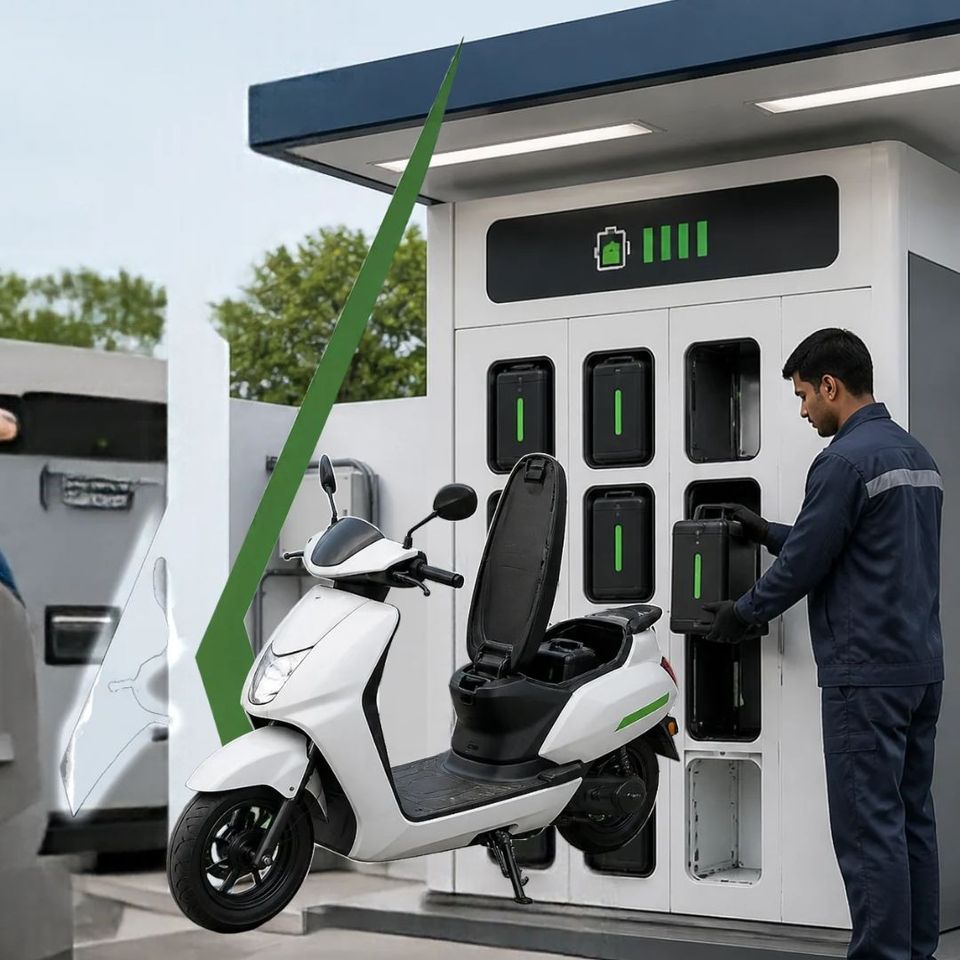
India's 3,500+ Battery-Swapping Stations Face Utilisation, Profitability Challenges: Study
India
November 5, 2026
Latest data indicates that India's battery-swapping industry is expanding, particularly in the electric two-wheeler (E2W) segment. According to India Ratings and Research (Ind-Ra), profitability, rather than demand generation, is likely to emerge as the key differentiator as the sector matures. Rising electric vehicle (EV) adoption, favourable economics for commercial fleets, and the rapid expansion of last-mile mobility ecosystems are expected to support this growth. The research indiacates the sector being at an early stage, with over 3,500 swapping stations compared with around 52,700 public EV charging stations as of July 2026. Despite the improving demand outlook, Ind-Ra's research finds that the industry's ability to generate sustainable returns will depend on operators' success in improving network utilisation and achieving operating leverage. Other factors, including broader original equipment manufacturer (OEM) participation and interoperability, will also influence profitability. The same are largely focused on major urban centres such as Delhi, Mumbai, Bengaluru, Chennai, and Pune, where commercial EV fleet adoption is relatively high and utilisation levels are sufficient to support station economics. Global Markets Offer Proof Of Concept In the global marekt, Ind-Ra report highlights how developments in Taiwan and China demonstrate that battery swapping can scale when supported by dense networks, high utilisation, and ecosystem-wide participation. Taiwan has developed one of the world's most mature two-wheeler battery-swapping ecosystems, while China has established a broader ecosystem spanning both two-wheelers and passenger vehicles. These markets highlight the importance of network density and interoperability in achieving scale and sustainable operating economics. India, however, remains at a much earlier stage of development. Profitable Scale Will Define Credit Strength Ind-Ra believes the industry's biggest challenge is unlikely to be demand generation but rather converting growth into sustainable profitability. While rising EV adoption, commercial fleet electrification, and expanding delivery ecosystems are creating a sizeable addressable market, operators must demonstrate that utilisation can increase sufficiently to absorb significant investments in battery inventory and network infrastructure. Given the sector's high upfront capital requirements and evolving cash-flow profile, expansion has largely been supported through equity funding, capital from the strong balance sheets of parent or promoter groups, and parent-backed debt. Ind-Ra's research indicates that operators with denser networks, stronger OEM partnerships, and broader interoperability are likely to be better positioned to strengthen profitability and generate sustainable returns as the industry evolves. Commercial Fleets Will Lead Adoption The rapid growth of e-commerce and quick-commerce platforms, alongside policy initiatives aimed at accelerating fleet electrification, is expected to support battery-swapping adoption. According to the Ind-Ra report, commercial mobility will remain the primary growth driver for battery swapping, given the significantly higher utilisation levels of delivery, logistics, and shared-mobility vehicles compared with personal vehicles. Battery swapping reduces charging downtime to a few minutes, improving vehicle availability, productivity, and driver earnings. “Commercial E-2W and E-3W fleets will drive battery-swapping adoption as operators seek to reduce vehicle downtime, improve asset productivity, and lower upfront acquisition costs. However, converting this demand into sustainable profitability will hinge on improving battery and station utilisation, achieving operating leverage, and scaling networks, while overcoming high battery inventory requirements and limited interoperability,” says Shruti Saboo, Director, Corporate Ratings, Ind-Ra. Ind-Ra's research also shows that battery swapping can provide a competitive and often lower total cost of ownership (TCO) for high-utilisation commercial fleets by reducing vehicle downtime, improving asset utilisation, and lowering upfront capital requirements. Under the swapping model, users typically purchase or lease vehicles without batteries and access them through subscription- or pay-per-use arrangements. This converts a portion of the upfront battery cost into an operating expense. While declining battery prices may narrow some of the upfront cost differential, the operational benefits of rapid energy replenishment are expected to remain intact. BaaS Will Improve Affordability Ind-Ra indicates that the Battery-as-a-Service (BaaS) model will remain an important enabler of EV adoption. With batteries accounting for 35%-40% of an E2W's cost, separating battery ownership from vehicle ownership lowers upfront acquisition costs while transferring battery replacement risks to the operator. Subscription- and usage-based plans could further improve accessibility for users. Battery swapping also supports the sustainability objectives of e-commerce and quick-commerce companies by facilitating fleet electrification and reducing carbon emissions. Adoption is further supported by policy initiatives, with states encouraging e-commerce and quick-commerce companies to transition towards EV adoption. For example, Delhi's EV policy proposes barring fleet aggregators and delivery service providers from registering new internal combustion engine (ICE) trucks. It also mandates government agencies to procure only electric light-duty trucks and sets specific cutoff dates: no new ICE three-wheeler registrations from January 2027 and no new ICE two-wheeler registrations from April 2028. Scale Will Matter More India's battery-swapping ecosystem comprises both infrastructure-led operators and OEM-linked platforms. Infrastructure-led operators establish and operate swapping networks that can cater to vehicles from multiple OEM partners, while integrated players typically combine vehicle offerings with a captive or partnered battery-swapping ecosystem. Upgrid Solutions Private Limited and Indofast Swap Energy Private Limited are among the larger infrastructure-led operators, with each operating over 1,600 swapping stations. Other participants include Ampup Energy Private Limited, Reddy Automotive Private Limited, E-Chargeup Solutions Private Limited, and Magna Yuma Private Limited. Integrated/OEM-linked ecosystems include Bounce Electric 1 Private Limited, Gogoro India Private Limited, and Honda Power Pack Energy India Private Limited. The industry remains fragmented, with differences in battery architecture and limited interoperability resulting in largely operator-specific networks. Ind-Ra makes a case for greater cooperation among operators. Those with wider network coverage, stronger OEM partnerships, and higher asset utilisation are likely to be better positioned to improve network economics and operating leverage as the industry matures. Larger networks can support higher swap volumes, better utilisation of battery inventory, and greater customer convenience.