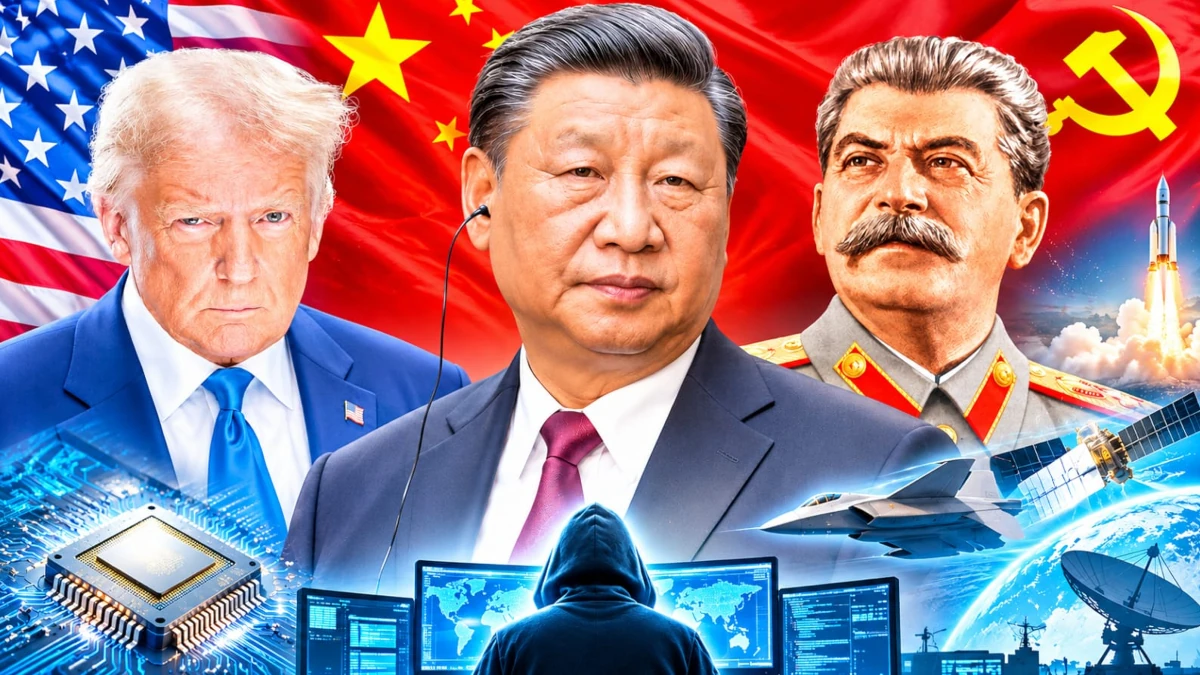
China and its stolen tech empire: How espionage drives rise of Beijing and poses a greater challenge than Soviet KGB
India
November 14, 2026
The espionage controversy surrounding Nvidia’s former CEO Jensen Huang has once again exposed the growing concerns over China’s intelligence operations targeting global tech companies. On November 8, US tech gaint Nvidia announced an independent investigation into reports that former co-founder and CEO Huang had a relationship with Alice Huang, a Chinese citizen and former executive of Singapore-based cloud-computing company Megaspeed, suspected by American authorities of being a Chinese intelligence asset. The espionage matter is now under investigation by American intelligence and law enforcement agencies, which are examining possible links between the Chinese businesswoman and Beijing’s intelligence networks, as well as potential violations of US export-control restrictions. The alleged espionage episode has drawn attention to a much larger issue that China’s decades-long efforts to acquire advanced foreign technologies through industrial espionage, cyberattacks, insider recruitment, intellectual property theft and covert technology transfers. From aircraft engines and stealth fighters to semiconductor manufacturing, nuclear weapons research, telecommunications and renewable energy, multiple investigations and criminal prosecutions have documented attempts by Chinese entities and spy operatives to obtain technologies developed through years of research and investment. For China, technological acquisition is closely linked to its ambitions to become a global superpower. Unlike conventional industrial competition, which relies on continous research, investment and innovation, economic espionage offers a shortcut to technological capabilities that Western competitors have spent billions developing. Under the Chinese Communist Party (CCP), intelligence collection has increasingly been directed towards strategic objectives, including strengthening Beijing’s military-industrial complex and reducing dependence on Western technology. 224 Espionage Cases: The scale of China’s technology hunt A March 2023 research paper by the US-based Center for Strategic and International Studies (CSIS), titled ‘A Survey of Reported Chinese Espionage, 2000 to the Present’, documented 224 reported instances of Chinese espionage targeting Washington since 2000. The CSIS report specifically excluded more than 1,200 intellectual property theft lawsuits brought by the US companies against Chinese entities in the US and China. It also excluded espionage against other countries and attempts to smuggle controlled advanced technologies. The CSIS study identified a strategic shift after Chinese communist leader Xi Jinping assumed leadership of the Chinese Communist Party (CCP) in November 2012 and became China’s President in March 2013. According to CSIS, 69 per cent of the 224 reported incidents occurred after Xi took power as President. The CSIS report observed that Chinese espionage increasingly served CCP’s long-term strategic objectives rather than merely benefiting individual military officers or commercial interests. It identified hacking, financial incentives, recruitment of insiders, sexual relationships, coercion, joint ventures and covert procurement through third countries as important Chinese methods. CSIS also cautioned that Chinese nationals working or studying abroad could become vulnerable to recruitment or coercion, particularly when they had close family connections in China. The scale of the espionage problem is also reflected in a 2017 estimate by the US Commission on the Theft of American Intellectual Property, which placed annual US economic losses from international intellectual property theft between $225 billion and $600 billion. This was an estimate covering multiple forms of intellectual property theft, not a verified annual loss attributable exclusively to China. From aircraft engines to nuclear technology: What China targeted The record of espionage investigations and prosecutions reveals the extraordinary range of technologies targeted by Chinese intelligence networks and commercial entities. Telecommunications – (United States 2000–2002): Hai Lin, Kai Xu and Yong-Qing Cheng, former employees and a consultant associated with the US telecommunications company Lucent, were charged with conspiring to transfer proprietary PathStar Access Server technology to a joint venture involving Beijing-based Datang Telecom Technology. The technology enabled voice and data communications over internet networks. A US Justice Department indictment announced on April 11, 2002, detailed the alleged transfer through electronic communications, password-protected websites and visits to China. Nuclear and Stealth Technology – (United States 2003): Chinese hackers reportedly penetrated systems at the US Naval Air Weapons Station China Lake, extracting national security information involving nuclear weapons testing and design, as well as stealth aircraft technology. CSIS included the incident in its 2023 espionage survey. Space Technology – (United States 2005): Chinese hackers infiltrated NASA networks managed by Lockheed Martin and Boeing, obtaining information relating to the Space Shuttle Discovery programme, according to the CSIS chronology of significant cyber incidents. Automotive Technology – (United States 2005–2006): Shanshan Du, a former General Motors engineer, copied 16,262 files, including confidential hybrid vehicle technology documents, onto a hard drive in February 2005. Her husband, Yu Qin, was pursuing business opportunities involving Chinese automotive competitor Chery Automobile. Both were convicted in November 2012 of offences involving GM trade secrets. The stolen material included information concerning hybrid motor controllers and electric vehicle engineering. Military Simulation Technology – (United States 2003–2007): Xiaodong Sheldon Meng, a former employee of Silicon Valley company Quantum3D, misappropriated military simulation software, including Mantis and viXsen. The software was used in military training, including fighter-pilot simulation and night-vision applications. In August 2007, Meng pleaded guilty to economic espionage and violating export-control laws involving technology intended to benefit China’s Navy Research Center. F-35 Fighter Aircraft – (United States 2007): Chinese hackers breached a Pentagon computer network serving the US Secretary of Defense in June 2007. Separately, cyberattacks targeting US defence contractors raised concerns over the acquisition of sensitive information associated with the F-35 Joint Strike Fighter programme. The potential relationship between acquired information and Beijing’s subsequent J-20 stealth fighter has attracted considerable scrutiny. Aerospace Technology – (United States 1979–2009): Dongfan Chung, a former Boeing and Rockwell engineer, was convicted on July 16, 2009, of economic espionage and acting as an agent of CCP. Prosecutors established that he had supplied China with restricted aerospace information, including technology relating to the Space Shuttle, the C-17 military transport aircraft and the Delta IV rocket. He was sentenced to 188 months in prison in February 2010. Titanium Dioxide Manufacturing – (United States): In another major industrial espionage case, Walter Liew and associates stole DuPont’s proprietary chloride-route titanium dioxide manufacturing technology and sold the information to Chinese state-owned companies. The process is used to […]