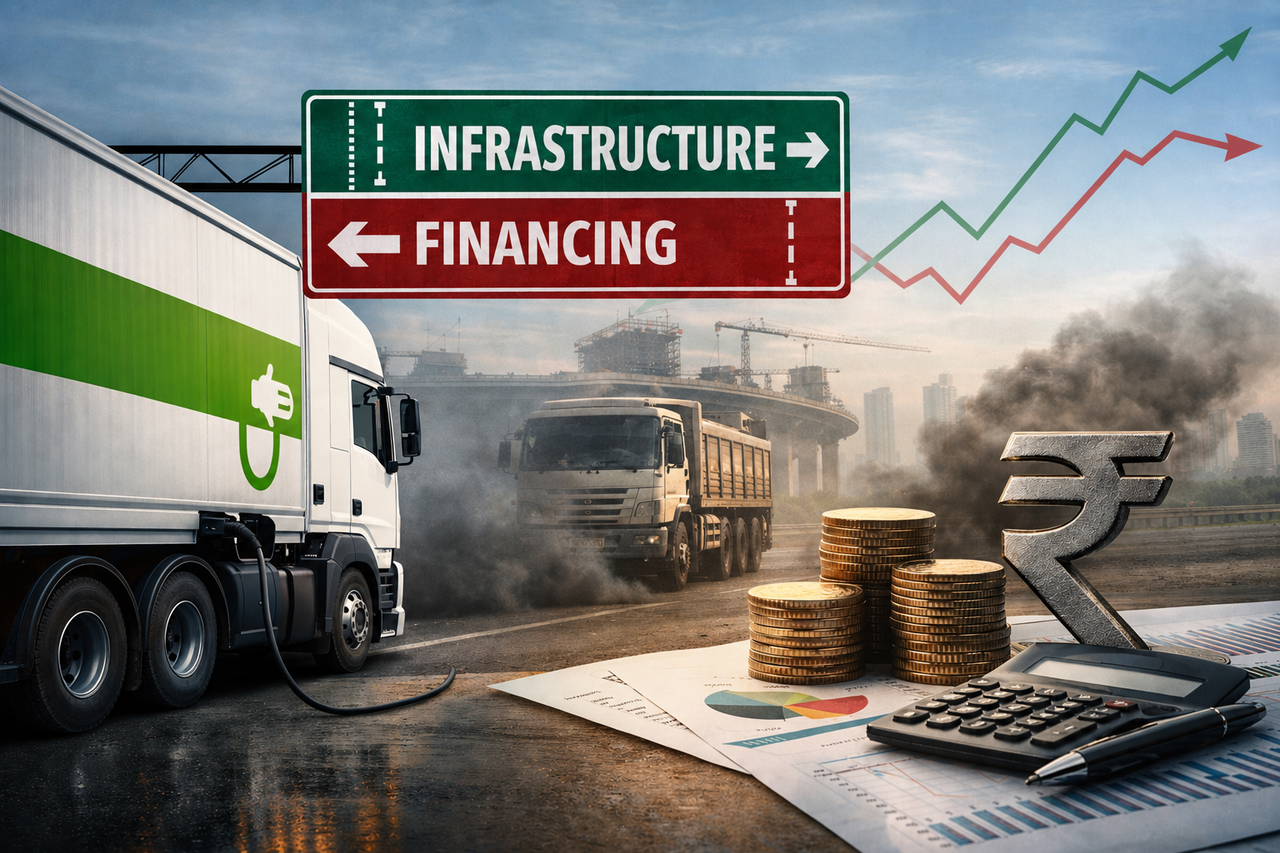
India’s Electric Truck Adoption Stalls Amid Financing and Infrastructure Gaps
India
May 1, 2026
After a surge in electric three-wheelers, India is beginning to carve out a niche in the heavy electric truck and e-bus market, though challenges persist. A report by NITI Aayog noted that trucks and buses account for just 4% of the country’s vehicle fleet but generate nearly half of its emissions, underscoring the urgency of electrification. However, adoption in these segments remains slow. India continues to lag in electric car and truck adoption compared with China , which dominates both segments. In contrast, India has made relatively stronger progress in electric two-wheelers and buses, even as growth in these segments has slowed in the United States, the European Union, and China. While electric buses have gained policy attention and market traction, electric trucks remain an underdeveloped segment despite government support. The PM Electric Drive Revolution in Innovative Vehicle Enhancement ( PM E-DRIVE ) scheme has extended incentives under the performance-linked mechanism for N2 and N3 category electric trucks, but uptake remains limited. States like Delhi offer incentives to electric four-wheeler goods carriers (N1 trucks), a scrappage incentive of Rs. 50,000 upon the purchase of a new electric vehicle. Delhi provides this incentive on purchase made within six months of CoD issuance. Additionally, this policy would incentive scrapping Delhi-registered BS-IV and older goods carriers in the N1 category. Electric Truck Charging Hinges on Grid and Infrastructure Expansion The International Council on Clean Transportation ( ICCT ) has emphasized developing a charging network as a key element in building electric truck infrastructure. It stated that India needs to develop a 9 GW charging network to support 1.3 lakh electric trucks by 2030. Its report, Charging Infrastructure Needed to Support India’s Full Transition to Battery Electric Trucks by 2050 , shows that charging demand for electric trucks is concentrated in five states—Maharashtra, Uttar Pradesh, Rajasthan, Gujarat, and Madhya Pradesh. Photograph: (ICCT) Currently, most state-level EV policies do not account for the grid upgrades required to support this transition. The report estimates that battery electric truck (BET) capacity will increase from 9 GW in 2030 to 171 GW by 2050. Without early coordination, grid constraints could delay charger commissioning and increase project costs. It also highlights the need for proactive grid planning to enable a cost-effective infrastructure rollout. The ICCT recommends developing time-bound interconnection processes, prioritising approvals for charging projects, and creating “e-truck-ready highways” and “e-truck-ready zones.” These zones should be located near freight hubs and integrated into state electricity regulatory frameworks. It further suggests the development of e-truck-ready highways and zones—also referred to as freight corridors or industrial areas—where charging infrastructure, grid capacity, and land availability are pre-identified and proactively developed to support BET operations. These deployment hubs and zones could reduce lead times for charging installation and encourage private investment. State Initiatives and Industry Tie-Ups Support E-Truck Expansion India has seen the rise of e-truck initiatives, including the construction of the country’s first commercial electric truck battery-swapping and charging station in Sonipat . The project is located at the Delhi International Cargo Terminal Private Limited (DICT) in Panchi Gujran village on the GT Road near Ganaur. In 2025, the Kerala government laid the groundwork to operationalise an electric truck corridor, aligning its freight electrification plans with the central government’s PM E-DRIVE scheme. Moreover, Kerala’s corridor-based approach could serve as a model for the national deployment of electric freight. Similarly, private investment and collaboration between companies such as Tata Power EV Charging Solutions Limited and VE Commercial Vehicles Limited promote electric commercial vehicles in India. Combined with the Ministry of Heavy Industries’ PM e-Drive scheme, it aims to stimulate local manufacturing in the electric mobility value chain and accelerate EV adoption in the commercial transport sector. They offer incentive structures and build performance eligibility criteria for electric trucks. Moreover, the scheme sets standards by using e-buses as a transitional benchmark for e-trucks until the effective dates of the PMP requirements are established. In India, companies like UltraTech Cement are scaling the use of electric vehicles (EV trucks) to move materials and products in their logistics operations, deploying around 500 electric trucks by June 2025 under the government’s eFAST initiative. The company is among the few cement companies in India to introduce ‘Green Logistics’ through electric trucks in 2024. Later, it entered into a transport service contract to deploy 100 EV trucks to transport 75,000 MT of clinker monthly from its cement manufacturing unit in Madhya Pradesh. Similarly, Volvo FH Electric , a long-range version of its FH Electric designed to operate on interregional and long-distance routes. Likewise, Sany India built a locally manufactured Electric Dump Truck SKT105E in India. Companies like A.P. Moller - Maersk are also exploring investment opportunities in land development for logistics hubs, warehousing facilities, and integrated hubs in states like Tamil Nadu , along with deploying electric trucks for distribution networks to support trade growth. Similarly, Blue Energy Motors Limited , an LNG and Electric heavy-duty trucks manufacturer, also secured fresh funding, bringing its total capital raised to $50 million. In the latest funding round, Blue Energy Motors raised an additional $30 million from Nikhil Kamath and Omnitex Industries. High Costs and Lending Risks Stall E-Truck Adoption Trucks and buses are natural candidates for faster electrification. Further, motorised two-wheelers constitute about 75% of the vehicle fleet and represent another key segment that needs to transition to electric. However, challenges such as inadequate financing for electric buses and trucks remain significant. According to NITI Aayog , focusing on the development of truck and bus leasing industries can make it easier for small operators to adopt electric vehicles. The report noted that only 6,220 out of 834,578 trucks sold in India in 2024 were electric. One of the key factors holding back the electric truck sector is financing, especially as the market is fragmented and dominated by small players. Strengthening leasing models could help address this issue. Challenges in financing electric trucks and buses arise due to risks perceived by financial institutions. Since these vehicles cost two to three times more than their ICE equivalents, the higher loan and equity requirements make it difficult for small operators to transition. Financial institutions are also uncertain about small players' ability to service higher EMIs. Additionally, the lack of reliable performance data for e-trucks and e-buses complicates lending decisions. High Upfront Costs Remain Key Barrier to E-Truck Adoption An assumed ex-showroom price of ₹1.5 crore per e-truck, with a 70:30 debt-to-equity ratio, results in a total requirement of ₹15,000 crore for 10,000 e-trucks, including ₹4,500 crore equity and ₹10,500 crore debt. Reducing interest rates from 18% to 12% through blended finance could significantly improve viability. Additionally, electric trucks and buses cost two to three times as much as their ICE equivalents. The high upfront cost and expensive loans create entry barriers for small operators. The lack of reliable performance data further increases uncertainty among financial institutions. Therefore, the NITI Aayog report suggests creating a blended finance mechanism, forming a committee of bankers to develop standardised valuation frameworks (similar to Germany), and introducing toll relaxations for e-trucks and e-buses. Another major factor affecting electric trucks is that sizes remain limited, with about 95% (5,940 units) being under 3.5 tonnes. These are primarily used for short-haul, urban freight. This sizing constraint affects their carrying capacity. In many countries, vehicles under 3.5 tonnes are not even classified as trucks. Only 280 electric trucks sold in India in 2024 exceeded this capacity and are suitable for long-haul operations. Recommendation: Pooled Fund for Financing Financing rates for diesel trucks and buses are around 10–12%, while EV financing costs are significantly higher at 15–18% due to perceived risks such as battery longevity and operational uncertainty. To address this challenge, the Government of India could establish a pooled fund in collaboration with multilateral development banks to provide concessional financing for e-trucks and e-buses. The goal would be to achieve parity in financing costs between electric and diesel vehicles. NITI Aayog also recommends using a pooled fund to reduce risks for lenders and accelerate the adoption of electric trucks.